The useful life of people: Extending the asset management mindset to workforce sustainability
From Camera to Code: Artificial Intelligence in Sewer System Condition Assessment
Articles
From Camera to Code: Artificial Intelligence in Sewer System Condition Assessment
October 15, 2026
Ryan Angelico, PE, Project Manager, Weston & Sampson, Reading, Massachusetts
Michael DiPalma, PE, Team Leader, Weston & Sampson, Reading, Massachusetts
Sewer collection systems are complex underground networks of pipes and structures that have been installed and maintained for over a century in communities throughout New England. Over the years, technological advancements have continuously evolved the industry, providing new ways to manage, operate, and inspect these systems. Early inspection methods dating back to the late 1800s involved the use of lamps and vertical shafts to identify obstructions, with newer methods involving modern video and robotic equipment.
Today, artificial intelligence (AI) software has quickly become a useful tool to improve efficiency for many otherwise cumbersome and laborious tasks, and the wastewater industry and its sewer collection systems are no different. Many firms have developed solutions for closed-circuit television (CCTV) review and video analysis. These software solutions use computer algorithms which have been trained to detect and classify defects, analyze video inspections, and provide codes and grades compliant with the industry standard, NASSCO, Inc.’s Pipeline Assessment Certification Program (PACP). With many firms pushing this technology forward, the industry has rapidly evolved over the last few years.
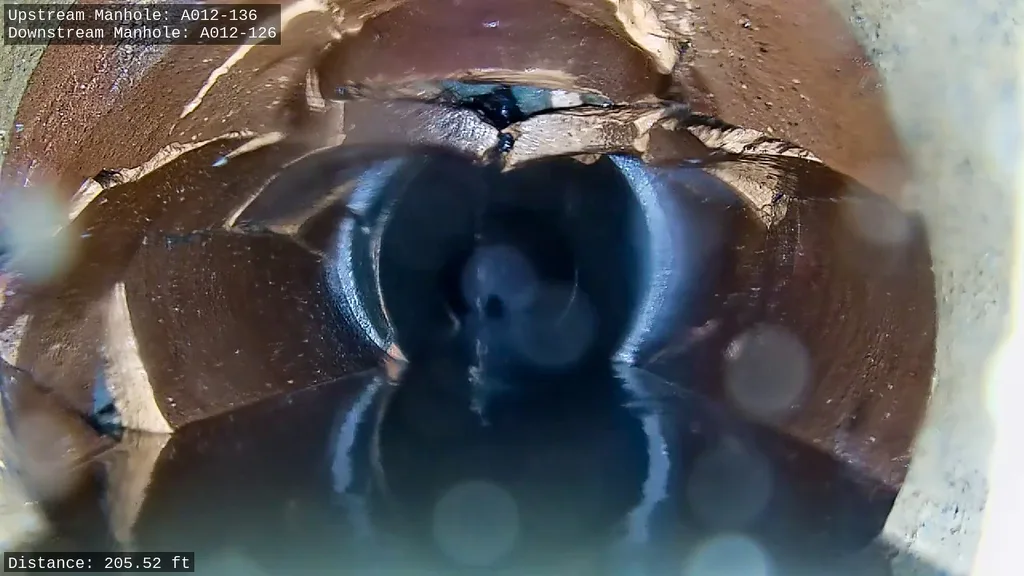
Figure 1: Sewer system evaluation surveys are comprehensive programs performed on gravity sewers to target structural defects and infiltration and inflow entering the system.
Sewer system evaluation surveys (SSES) are comprehensive programs performed on gravity sewers to target infiltration and inflow (I/I) entering the system. SSES programs typically involve field investigations performed during a period of high groundwater, which is defined by the Massachusetts Department of Environmental Protection (MassDEP) as March 1 to June 30 . As such, CCTV inspection is usually performed in the spring to identify specific sources of infiltration entering sewers.
SSES and other condition assessments are important programs for municipalities, as they allow the communities to prioritize areas within their systems to target rehabilitations with the aim of reducing I/I flows (Figure 1). Reduction of I/I:
helps prevent both sanitary sewer overflows (SSOs) and combined sewer overflows (CSOs),
increases system capacity, and
complies with guidelines and similar regulatory requirements.
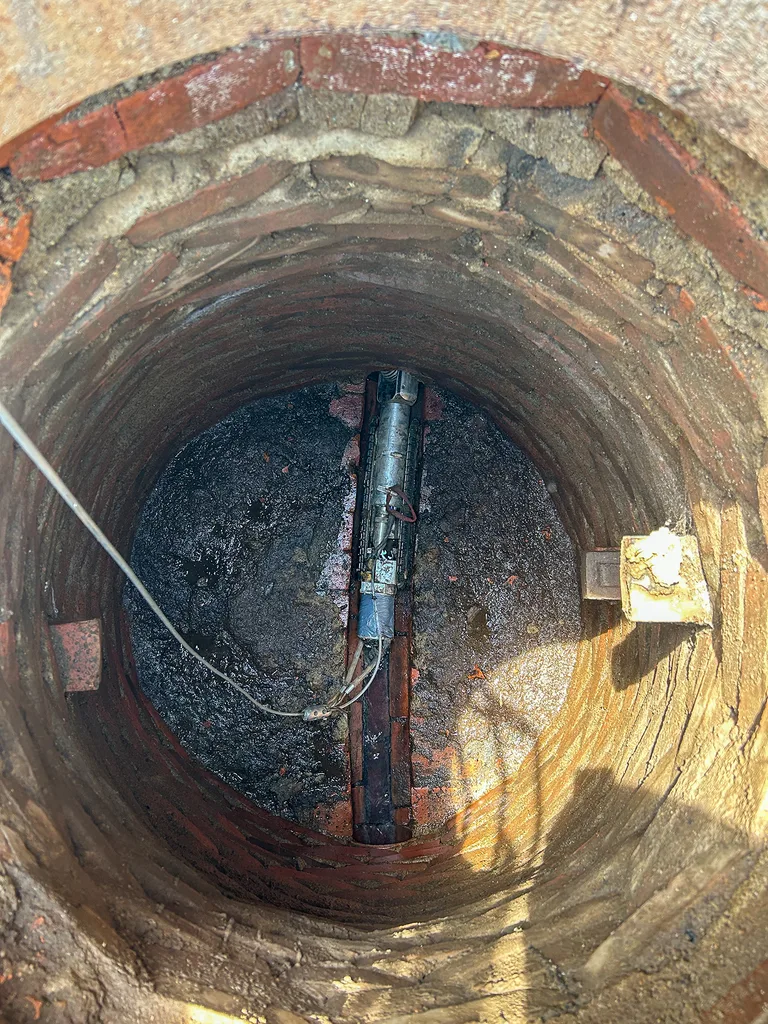
These programs also help improve overall asset management for sewer system infrastructure. CCTV inspections involve operating a robotic crawler, mounted with a camera, through the gravity sewer. Per industry standards, a trained and certified operator, following the standards set forth by the PACP, guides the camera through the pipe to identify defects and other conditions observed through television inspection (Figure 2). Defects and observations are entered into the inspection software using standardized codes set by PACP for consistency across the industry. CCTV inspection, while targeting I/I sources, also offers the benefit of identifying structural issues (e.g., cracked, fractured, broken, or collapsed pipe, etc.) as well as operation and maintenance issues (e.g., grease, mineral deposits, root intrusions, etc.). Prior to the standardization of PACP in 2002, CCTV inspection documentation of defects and observations was often inconsistent and highly dependent on the individual operator and technician. PACP defect codes and operator training helped reduce inconsistencies in inspections and provided a standard for which subsequent evaluations are performed. Still, CCTV inspections rely on skilled operators to identify and record observations.
TRADITIONAL VIDEO ANALYSIS METHOD
PACP-trained and certified wastewater engineers often review CCTV inspection videos and data in the office after field investigations have been completed. This review helps provide an enhanced level of consistency and conformance to PACP standards, as well as a professional assessment of preliminary design recommendations based on the observations identified during each inspection, which are recorded and cataloged into project databases. Defects are identified and preliminary design recommendations are included on a pipeline-by-pipeline basis.
Figure 2: CCTV inspections involve operating a robotic crawler, mounted with a camera, through the gravity sewer following the standards set forth by the PACP.
In addition to reviewing the video, engineers can estimate I/I rates to support rehabilitation prioritization. A cost-effective analysis comparing the overall rehabilitation cost to an estimated transportation and treatment (T&T) cost of removable I/I can be performed. Additionally, pipes with severe structural defects or operation and maintenance (O&M) issues can be identified and prioritized accordingly.
While the engineer’s review is an important step in the overall process, the effort is nonetheless time consuming and labor intensive. Analyzing the data from CCTV inspections can often be one of the most labor-intensive tasks in the overall investigation which, depending on the size of the project, can take weeks to complete.
AI SOFTWARE PLATFORM AND WORKFLOW IMPLEMENTATION
With recent advancements in AI-powered inspection software, our team evaluated multiple AI software offerings with the goal of improving efficiency and providing a higher level of service to our clients. We tested the software on legacy projects to monitor AI-generated observations compared to previously recorded observations logged by PACP-certified operators and reviewed by a PACP-certified engineer. We found AI coding quality to be similar across the offerings we evaluated but found large differences between pricing and the quality of user interfaces. Upon completion of our evaluation, we partnered with an industry leading sewer inspection software company to further test and implement AI-assisted review into our projects.
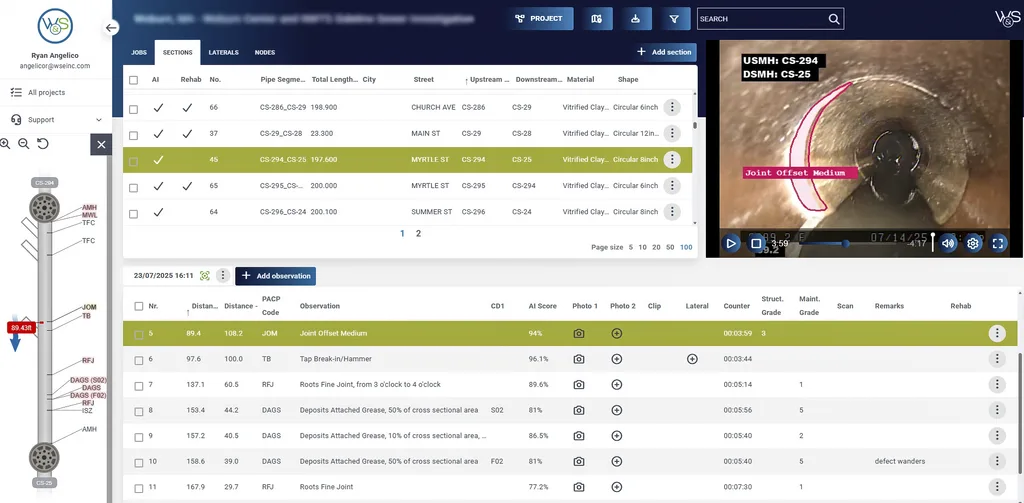
The software we selected utilizes a web-based interface that stores and organizes inspection data uploaded and/or generated within the platform. Data is structured hierarchically, with the highest level consisting of individual projects or jobs, allowing multiple projects to be maintained independently. Within each project, pipe assets are organized into a section table which allows sorting, filtering, and data management. Selecting a specific pipe section loads all of its associated inspection data, including observation records and linked video files, within a unified view to facilitate efficient review.
The interface synchronizes the observations with the embedded video file, enabling users to navigate directly to the corresponding timestamp for each recorded defect. Once data is uploaded or created, users can manage and review inspection data, run AI scans to automatically generate condition codes, and produce reports. Project data can be exported to a PACP-compatible database for further use in external applications and planning level evaluations.
We worked with the software vendor to customize the interface, including the use of custom fields within each asset’s section record. These fields allow engineers to incorporate supplemental asset information which includes overall pipeline recommendations, comments, or asset notes which are later utilized for reporting or data filtering. In addition, we configured our platform so engineers could incorporate preliminary rehabilitation recommendations and quantify infiltration rates/unidentified service flow for use in subsequent reporting and cost-effective analysis (Figure 3).
The integration of these custom fields allows the AI-assisted review process to align with our own planning level assessments. These customized fields provide the engineer with the ability to input supplemental data based on their review while maintaining one data set.
Figure 3: Customized web-based AI interfaces display project information, including pipe sections, observations, and linked video files within a unified view for efficient data management and review.
AI EVALUATION AND TESTING
We implemented AI-assisted coding on a recent sewer inspection project using CCTV data collected by PACP-certified operators. The contractor provided both video files and a corresponding PACP database, which were uploaded to the AI platform for analysis. The PACP database serves as the foundation for the workflow by defining pipeline assets (PACP inspection table) and associated inspection observations (PACP condition table) while also establishing the structure required to link inspection records to their corresponding video files within the platform.
We found that the data import process is a critical step for successful integration with the AI software. The platform utilizes the PACP media inspection table, specifically the file name and file path for the video file, to automatically associate each video to the corresponding inspection record. We have found that retaining the file structure and uploading the videos and database in the PACP format is essential to ensuring proper linkage and enabling subsequent AI coding. Prior to upload, QA/QC of the dataset is recommended to identify and correct issues such as incorrect asset IDs or broken file paths, which can otherwise disrupt the automated upload process.
Through our testing, we found that manually linking video files to inspection records is possible through the software’s web interface, although this process is significantly less efficient. For large datasets, we found the most efficient way is to utilize the PACP database tables to automatically link asset information with the video files.
We recommend special care be taken with sewers that require multiple inspections (i.e., reversal inspections). We found that reversal inspection records and videos should be reviewed for consistent data collection after importing the larger dataset to prepare separate inspections for an AI scan. We observed that the second (or reversal) inspection video would not always upload or link automatically to the pipe section. In these cases, the reversal inspection would need to be manually uploaded and linked to the appropriate pipe section within the interface.
Once the data and video files have been uploaded to the web-based interface, the engineer can initiate the AI-scan of the data. For a project of approximately 30,000 linear feet (LF) (9,144 meters (m)) of inspected sewers, the scan was completed overnight and ready for the engineer to review the following day. Scanned sections were incorporated as new observation records, separate from the PACP-certified operator record.
The video recognition AI records observations based on the observed footage/distance and assigns a PACP code and corresponding observation description based on the detected scan. PACP structural and O&M grades, along with remarks, were assigned automatically. These were then used to populate the overall ratings for the pipeline, consistent with PACP guidelines. The AI scan also populates an AI score column, presented as a percentage from zero to 100. This score represents the confidence interval determined by the video recognition AI for the certainty of the defect identified.
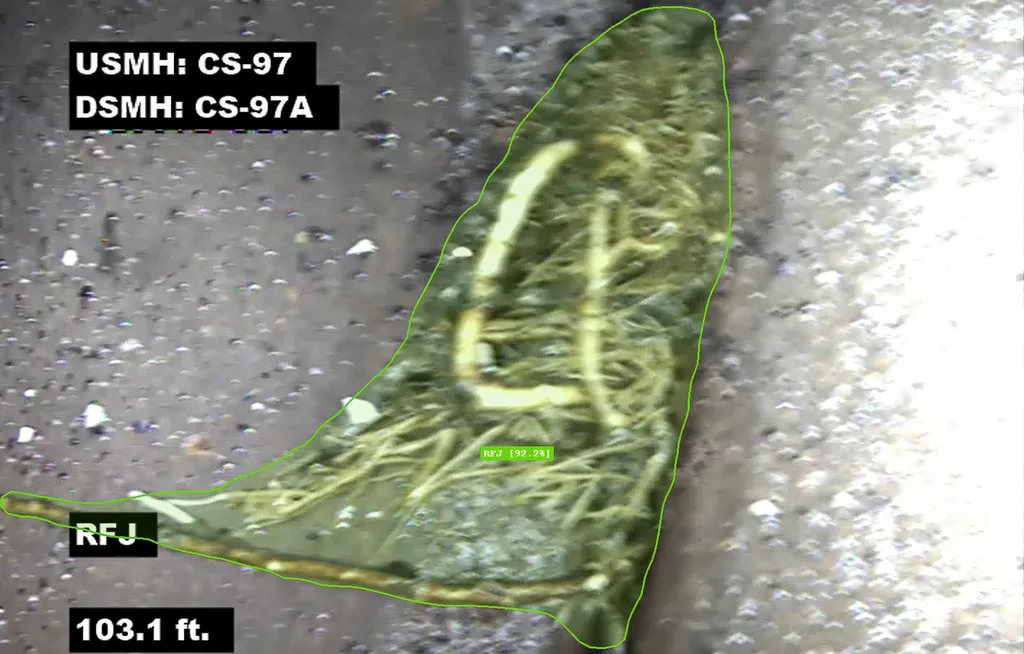
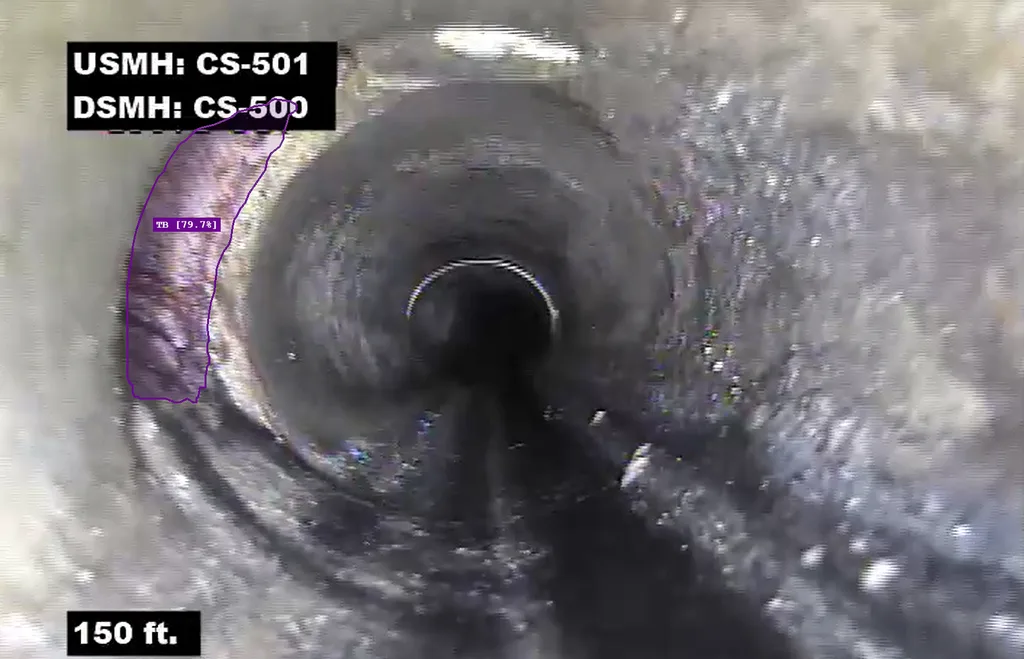
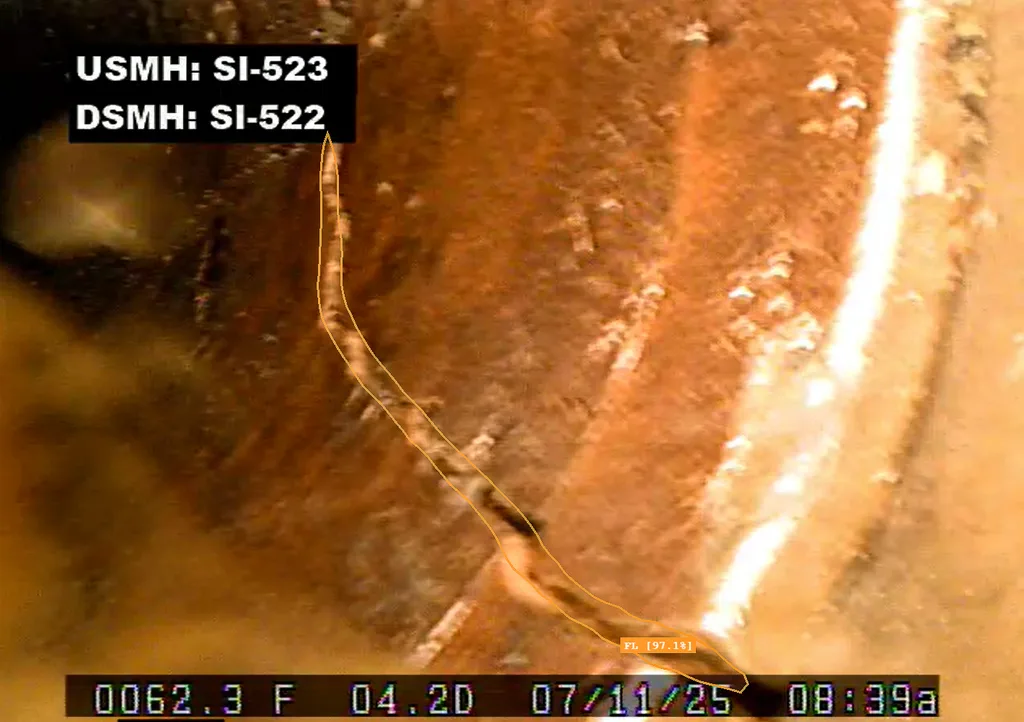
The video inspection file uploaded to the web platform is also updated following an AI scan. The identified observations detected by AI are highlighted in the video with a translucent color overlay which also identifies the PACP defect code and the AI confidence score, presented in brackets (Figures 4-6). This is a useful tool during engineer review of the data as it allows the engineer to specifically identify the defect which the AI scan has detected and confirm if the observation is consistent with PACP guidelines and the engineer’s professional judgement.
Figure 4: Screenshot from an updated video inspection file following an AI scan. The green overlay depicts Roots Fine Joint (RFJ) with an AI confidence interval of 92.2%. The text within the black box are video overlays from the certified operator where they indicated an RFJ at 103.1 feet.Figure 5: Screenshot from an updated video inspection file following an AI scan. The purple overlay depicts Tap Break-in/Hammer (TB) with an AI confidence interval of 79.7%.Figure 6: Screenshot from an updated video inspection file following an AI scan. The orange overlay depicts Fracture Longitudinal (FL) with an AI confidence interval of 97.1%.
To guarantee accuracy of the data collected for our clients, our engineers reviewed each inspection after the AI scan to ensure accuracy and consistency with industry standards. We currently do not rely solely on AI-assisted observations to make design recommendations for pipelines or identify I/I sources. Rather, our current evaluation process leverages AI to establish the basis for which the engineer can review and provide preliminary design recommendations. We believe that further engineer evaluation is still required to QA/QC the data and make design recommendations. The web-based platform, combined with a unified interface and the embedded video timestamp integration, allows the engineer to efficiently review observations and remarks identified by both certified operators and the AI scan and make design recommendations. The expectation is that as AI accuracy improves, the process will increase overall efficiency even further by reducing the amount of time spent performing time-consuming review and evaluation of CCTV videos.
RESULTS
After comparison and review, we determined that the video recognition AI successfully identified most standard defects. Even defects with relatively low confidence scores appeared to accurately represent the observed defect in most cases. We found that some inconsistencies between the AI-driven and human-led review included:
missed or miscategorized service connections,
misclassified infiltration, commonly at service connections or in sewers with turbulent flow conditions,
duplicate observations,
inconsistent detection with material changes within the pipeline,
misidentified roots or obstructions,
misclassified manhole structures, and
assessment capabilities for sewers with multiple inspection records (i.e., reversal attempts).
Observations or defects located within service connections fall under NASSCO’s LACP inspection program; however, modifiers are used for tap codes in PACP inspections to identify general defects in laterals. Observations or defects located in service connections were frequently coded incorrectly. We believe this was in large part because the video recognition software often codes and calls these out ahead of the physical feature in the pipe.
For example, a service connection located at STA 0+90 may be identified and recorded by the video recognition AI at STA 0+87, which is prior to the TV operator panning the camera inside the lateral to determine capped or active connections. Additionally, service connections are occasionally missed by the AI review and not cataloged in the overall pipeline record. These services appeared to regularly correspond with services located at the 11:00 to 1:00 position within the pipeline.
Infiltration sources were found in some instances to be misrepresented and required QA/QC. Normal usage or unidentified service flow from lateral connections was often coded as an infiltration defect. In some instances, turbulent flow conditions within sewers, where flow splashed against the camera lens or pipe walls, were identified as infiltration.
We found that, at times, defects were duplicated and the same defect, which was commonly roots, was identified and recorded more than once. This seemed to correspond to defects located near lateral connections where the defect was coded prior to panning into the lateral and again after the CCTV operator would pan away from the lateral connection.
Other inconsistencies included the identification and subsequent miscategorization of continuous defects. Often, individual O&M-related deposits or roots were misidentified and assigned a continuous defect rating. This would subsequently report a higher PACP grade for O&M defects than may have been accurate. Other defects were found to follow similar patterns, making the PACP ratings generated after AI-assisted review questionable for a pipeline in which continuous defects were coded by the AI.
TAKEAWAYS AND LESSONS LEARNED
The accuracy of pipeline observations is critical to driving accurate rehabilitation and design recommendations to target areas of need. Based on our work to date, the generated results still required QA/QC by certified engineers to ensure accurate results and design rehabilitations.
A clearer understanding of how AI codes sewer inspection videos will support more consistent inspection records aligned with PACP standards. Consistent CCTV operation during field collection, following PACP guidance, provides uniform data that supports improved AI training and performance. CCTV data collection optimized for AI-assisted review would improve the overall accuracy of the AI scan, broaden its use cases, and improve efficiency in the field during data collection.
AI-driven data review is not going away, and it is something that our firm will continue to develop, evaluate, and incorporate into projects to provide a high level of service to our clients. Video recognition and AI software will certainly improve as these programs continue to be tested and applied to real-world applications.
With that said, AI-driven assessments in our opinion will not replace the role of the operator, engineer, or reviewer but will rather be used as another tool to improve efficiency, consistency, and accuracy. The rise of AI is ever-present in today’s landscape, but human-led review and experience still have immense value and cannot be replaced.
ABOUT THE AUTHORS
Ryan Angelico, PE, is a project manager at Weston & Sampson in Reading, Massachusetts, with nine years of experience in the planning, design, and construction of water, wastewater and stormwater systems. He earned his BS in Civil Engineering from Wentworth Institute of Technology
Michael DiPalma, PE, is a team leader at Weston & Sampson in Reading, Massachusetts, with 14 years of experience related to the planning, design, and construction of water, wastewater, and stormwater systems. He earned his MS in Civil Engineering from Worcester Polytechnic Institute and his BS in Civil Engineering from Wentworth Institute of Technology.
[1] Massachusetts Department of Environmental Protection (MassDEP), “Guidelines for Performing Infiltration/Inflow Analyses and Sewer System Evaluation Surveys” May 2017