Articles

When the City of Revere set out to develop an urban forestry master plan for their Shirley Avenue neighborhood, they asked Weston & Sampson to assist them in their efforts. A typical urban setting, it has a limited existing tree canopy and suffers from the effects of urban heat island during the hot summer months. In fact, according to data from the Massachusetts Executive Office of Energy and Environmental Affairs, the neighborhood falls within the top 5% of the highest land surface temperatures in the region.
Our team began by inventorying the existing trees for species and current health conditions, which enabled us to determine which trees should be removed and which should be protected. We also considered factors like conflicts with overhead utilities and the effects the trees had on the accessibility of sidewalk conditions. Of the 192 trees inventoried, we found that 45 should be removed due to poor health within a year or so and that a further 94 should be removed over the next five years. Finally, we developed a palette of street trees that could thrive in an urban environment like this one, which included honey-locust, green vase zelkova, pin oak, American elm, and ginkgo.
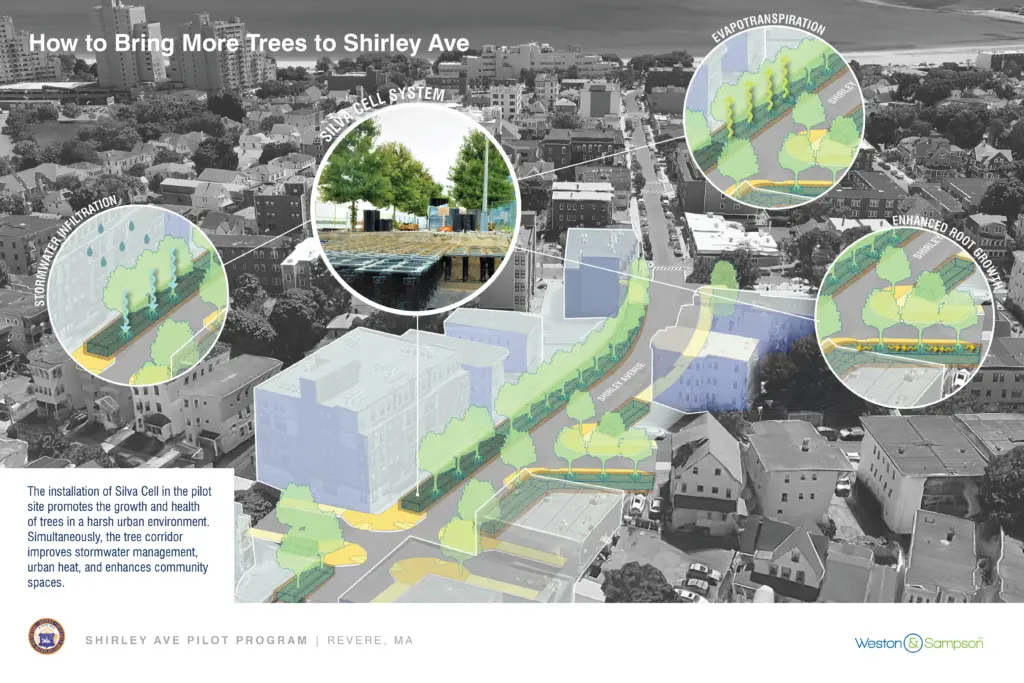
We presented these findings to the city and the neighborhood’s residents to help determine the next steps to achieve the overall goal of reducing sidewalk temperatures. Other goals included reducing stormwater run-off into the existing subsurface infrastructure and enabling residents to gather comfortably at certain locations in the neighborhood. We chose an area of two city blocks along Shirley Avenue to design and implement a pilot program for the planting of new street trees, along with green infrastructure technologies to better manage stormwater run-off.
This new approach to streetscape design presents a forward-looking vision of climate-resilient urban infrastructure, where healthy street trees and integrated green systems work together to transform the public realm. Central to the concept is an underground Silva Cell system — a modular soil-support framework that dramatically increases the volume of high-quality soil available to street trees while also capturing and storing stormwater. Rather than sending runoff into overburdened sewers, the system allows water to infiltrate slowly into the ground, supporting long-term tree vitality and reducing localized flooding. Additionally, the incorporation of areas of porous paving also helps to mitigate the effects of stormwater on the neighborhood.
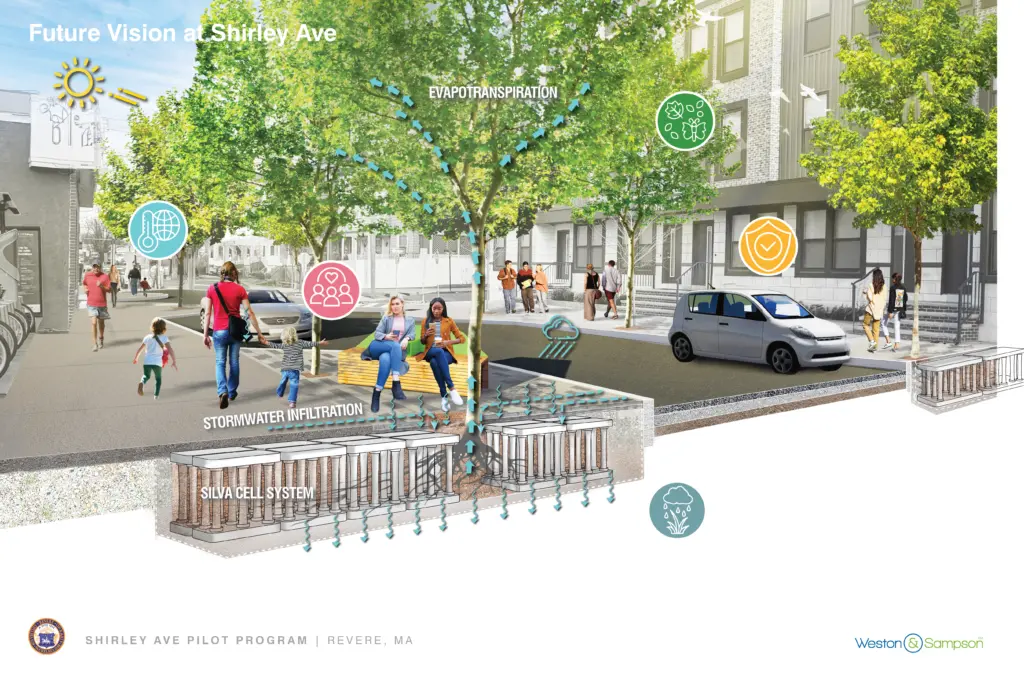
Above ground, the design directly addresses one of the most pressing urban climate challenges: the urban heat island effect. Conventional street designs, dominated by dark asphalt and exposed concrete, can become several degrees hotter than surrounding vegetated areas, intensifying heat stress for residents. However, a mature and strategically placed tree canopy interrupts that pattern. The 29 new trees that were installed will cool the environment not only through the shade they provide but also through evapotranspiration — a natural process that releases moisture into the air which can significantly reduce ambient temperatures. As a result, the street surface remains cooler, pedestrian comfort improves, and the need for energy-intensive cooling in nearby buildings can be reduced.
The design further enhances the pedestrian experience by offering wide, shaded sidewalks and integrated seating areas with new benches that encourage social activity even on hot days. These amenities transform the street into a space where ecological performance and human comfort are inseparable. While vehicles still share the roadway, the street’s identity shifts toward a greener, more livable environment that actively counteracts the climatic stresses of urbanization.
Altogether, the project demonstrates how a carefully engineered relationship between soil, water, and tree canopy can turn an ordinary block into a climate-responsive public space — one that mitigates heat islands, manages stormwater sustainably, and elevates the everyday experience of city life. If this pilot program proves to be successful, the city will use these technologies as their standard construction method for future streetscape renovation projects.
Published in NEREJ December 2025.


