Articles

In Worcester’s Broad Meadow Brook watershed, a concept design envisions how a schoolyard could evolve into both a vibrant learning space and a climate-resilient community asset. At Rice Square Elementary School, a preliminary vision explores integrating nature-based solutions to manage flooding while enhancing outdoor play and learning. Shaped through a co-design process with local stakeholders, this early-stage concept illustrates how communities across the state might reimagine public land like schoolyards, parks, and other municipal properties as multi-benefit infrastructure that advance resilience and neighborhood well-being, even before detailed design or construction begins.
Rice Square Elementary School: Site and Context
To ground this vision in place, the work at Rice Square Elementary School sits within a larger effort – the Broad Meadow Brook Restoration Project. Our team, in partnership with the Massachusetts Division of Ecological Restoration (DER), Mass Audubon Society, City of Worcester, Princeton Hydro, and the Blackstone Watershed Collaborative, worked on the Broad Meadow Brook Restoration Project with the aim of reducing stormwater-driven impacts and improve ecological conditions within the Broad Meadow Brook Wildlife Sanctuary and its upstream watershed.
Spanning 400 acres across southern Worcester, the sanctuary is managed by Mass Audubon and features woodlands, fields, streams, and a wetland system fed largely by runoff from the city’s storm drain network. The watershed contributes flashy, warm, nutrient-laden flows to the brook, stressing ecological conditions and exacerbating downstream flooding.
Previous project efforts included a desktop screening and prioritization of stormwater opportunities, while the current phase advances site-specific stormwater strategies at the highest ranked project clusters. The U.S. Environmental Protection Agency (EPA) defines best management practices (BMPs) as strategies which “focus on preventing pollutants from contacting stormwater.” As one of these high-priority BMP clusters, the Rice Square Elementary School, was selected as a pilot study site. The project focuses on implementing nature-based stormwater solutions to reduce peak flows, mitigate flooding in adjacent Environmental Justice neighborhoods, and improve water quality entering the sanctuary. The team worked to reflect these priorities in the design while also recognizing the current schoolyard’s blank canvas as an opportunity to reimagine the space.
That opportunity reflects a broader design challenge in that, with conventional grey infrastructure, function often takes precedence over form. Within the constraints of developed urban environments where municipally owned land is limited, there is a growing need to weave creativity and multi-purpose elements into traditional infrastructure design. Built spaces can be reimagined to serve dual purposes and respond to the needs of those who use them. Moving past the desktop analysis, our interdisciplinary team drew on their varied backgrounds and stakeholder input to ground the project not only in the resilience of hardscaped infrastructure (i.e., the stormwater system or pavement) but also in the social and environmental dimensions of resilience.
The Co-Design Process — Collaboration and Community Voices
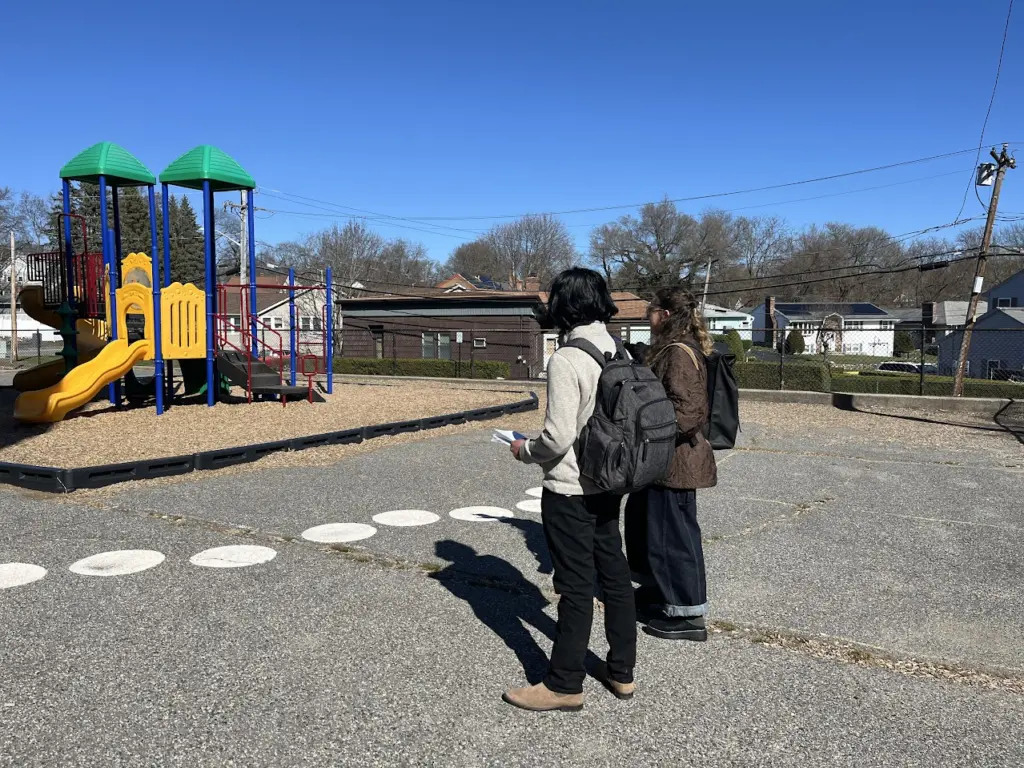
The co-design process centered on collaboration and elevating community voices to better understand how people use the space. This included meeting with the principal, teachers from another school, and a Woo-Labs Hanover Fellow who is currently working with students from the Rice Square Elementary School. Woo-Labs is a Worcester-based coalition of partners providing students with hands-on project-based learning in out-of-school time to promote their academic and social-emotional growth. Through these conversations, we heard their concerns, learned what they were looking for, and explored how our work could support their goals.
The key community priorities that shaped the design were:
- Safety and visibility of play areas
- Year-round usability for the entire community
- Low-maintenance landscaping
- Educational opportunities tied to curriculum
The Concept Design — Nature-Based Solutions in Action
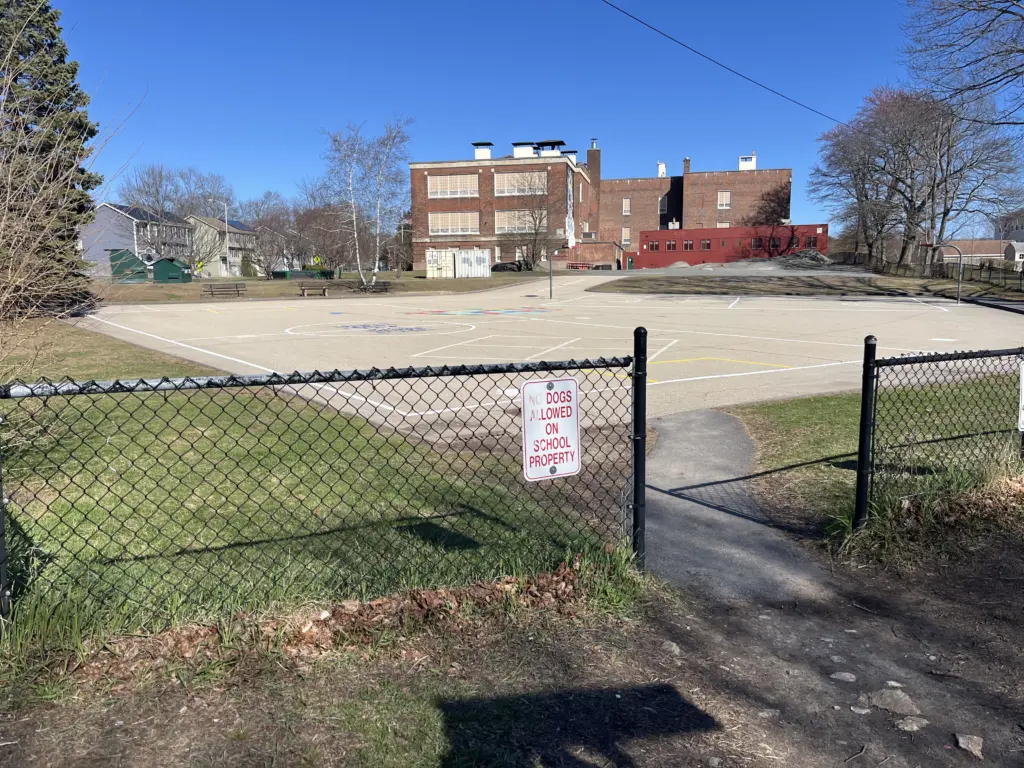
By drawing on community conversations, the design moved beyond desktop analysis and grew into a plan for nature-based solutions shaped by lived experience. Through this process, the team gained a clearer understanding of how the site was used and how its conditions supported opportunities to add tree canopy and green space. The goal was to align with the priorities shared by the principal and the Woo-Labs Fellow. They also noted the large expanse of asphalt, pointing to a clear opportunity to turn impermeable surfaces into green, resilient spaces.
To understand how these opportunities could take shape on the ground, the team looked closely at the existing conditions of Rice Square Elementary. The school is comprised of a central building surrounded by grassed lawns, a paved parking lot, a paved playground, and a paved baseball diamond. The parcel, just over two acres in size, is covered by about 60% impervious surfaces. The right-of-way in front of the school is also entirely impervious. Other site constraints include an extensive presence of ledge, high traffic, and a lack of tree canopy. Meetings with the principal and the Woo-Labs Fellow both stressed how little green space was available to the students. Proposed BMPs at the school were designed to improve stormwater retention and mitigate urban heat impacts while also supporting a more functional and engaging schoolyard environment.
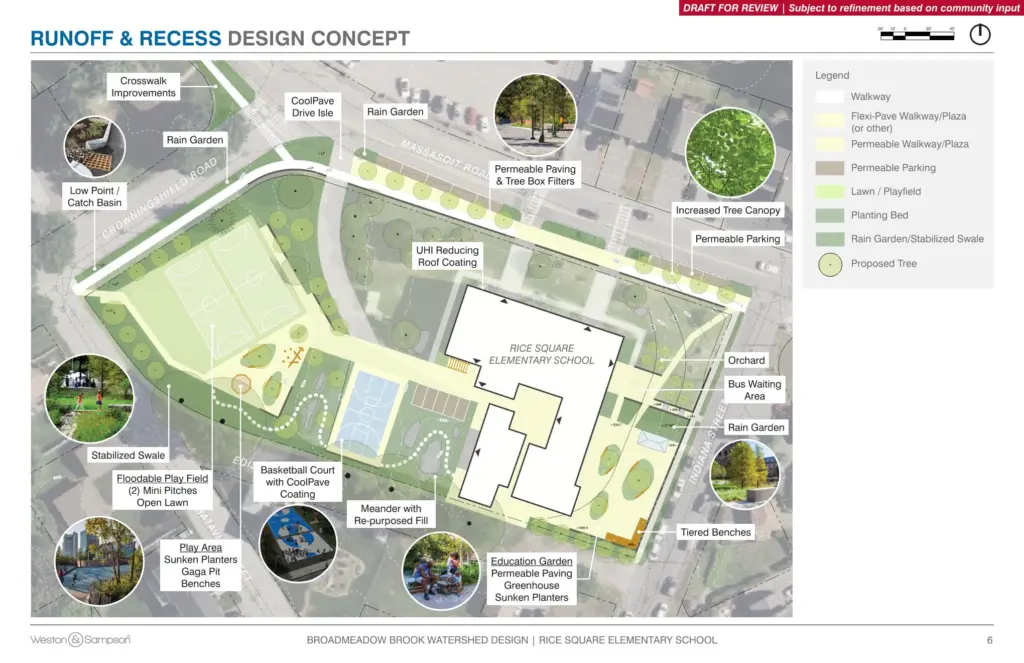
One key BMP opportunity was the reconfiguration of the schoolyard parking area. The project team learned that most faculty and parents park in a nearby lot or within the surrounding neighborhood, so the proposed design explores reducing the overall number of on-site spaces and formalizing them with striping. Incorporating permeable paving in these proposed bays would help decrease impervious surfaces, support on-site infiltration, and free up additional space for play.
Other proposed BMPs include:
- Rain gardens
- Permeable paving
- Subsurface storage
Defining BMPs
- Permeable paving – Permeable paving replaces an impermeable paved surface with a surface that water can seep through. Infiltrating the runoff will allow for reduced runoff downstream and slower infiltration back into the ground or stormwater system.
- Bioretention basin and rain garden – Bioretention basins capture and hold stormwater runoff and allow it to slowly infiltrate through soil media. Plantings will uptake water as well as nutrients in the runoff, helping manage both water quality and quantity.
- Subsurface infiltration chambers – Subsurface infiltration chambers are large underground systems that can be placed below pervious or impervious surfaces such as parking lots, parks, or fields. Stormwater is collected at the surface and directed into plastic or concrete storage structures. When it rains, stormwater is stored temporarily in subsurface structures until it can infiltrate into the ground. Subsurface infiltration chambers should be employed in combination with pretreatment measures to improve water quality before the water is infiltrated into the ground and to help prevent clogging.
BMP features are located within and around existing paved areas and parking lots to maximize stormwater benefits while minimizing disruption to school activities. This siting strategy supports effective runoff management and heat mitigation.
From Concept to Implementation — Why Early Planning Matters
Big ideas start with clear plans. Early concept designs give communities a roadmap for grants and budgets so they’re ready when opportunities arise. At Rice Square Elementary, the vision positions Worcester to pursue future funding through Massachusetts MVP Action Grants, federal resilience grants, and private foundations. Just as important, design visuals help everyone, from decision-makers to neighbors, see what’s possible and get excited about providing valuable feedback and insight that helps bring resilient, community-driven spaces to life.
A Model for Resilient, Multi-Benefit Public Spaces
Rice Square Elementary offers a model for how cities and towns can rethink their public spaces. The key is to think holistically, weaving hydrology, ecology, and community needs together. Early and frequent engagement not only strengthens design quality but also builds political and public support.
This project showcases the possibilities of transforming underutilized public land into high-performing community assets. It also shows that stormwater management doesn’t need to be hidden – it can be celebrated as a part of everyday life.
Across Massachusetts and elsewhere, communities can reimagine their own parcels to meet environmental mandates while enhancing livability. The path forward begins with creative, community-informed planning.
Originally published in Massachusetts Planning Magazine Fall 2025.


