Articles

Climate change is one of the most pressing challenges of our time, and the transportation sector plays a significant role in exacerbating this issue. As greenhouse gas (GHG) emissions continue to rise, global temperatures are intensifying the demand for greener technologies and more sustainable solutions.
One promising solution that has gained significant traction is the adoption of electric vehicles (EVs), which produce no tailpipe emissions. However, the widespread adoption of EVs hinges on the availability of a robust and strategically located vehicle charging infrastructure. Siting new charging stations is a critical step in facilitating the transition to sustainable transportation, and municipal public works departments can play a major role in this transition.
This article explores the importance of a data-driven approach to siting new EV charging stations. Leveraging data analytics and geospatial modeling techniques can identify optimal locations that maximize accessibility, convenience, and utilization while minimizing infrastructure costs. A comprehensive analysis of factors like population density, traffic patterns, existing charging station locations, and existing infrastructure can develop a framework for deploying new charging stations in high demand areas.
Key Challenges Facing EV Adoption
As society transitions toward a more sustainable future, the widespread adoption of EVs is crucial. However, several challenges must be addressed:
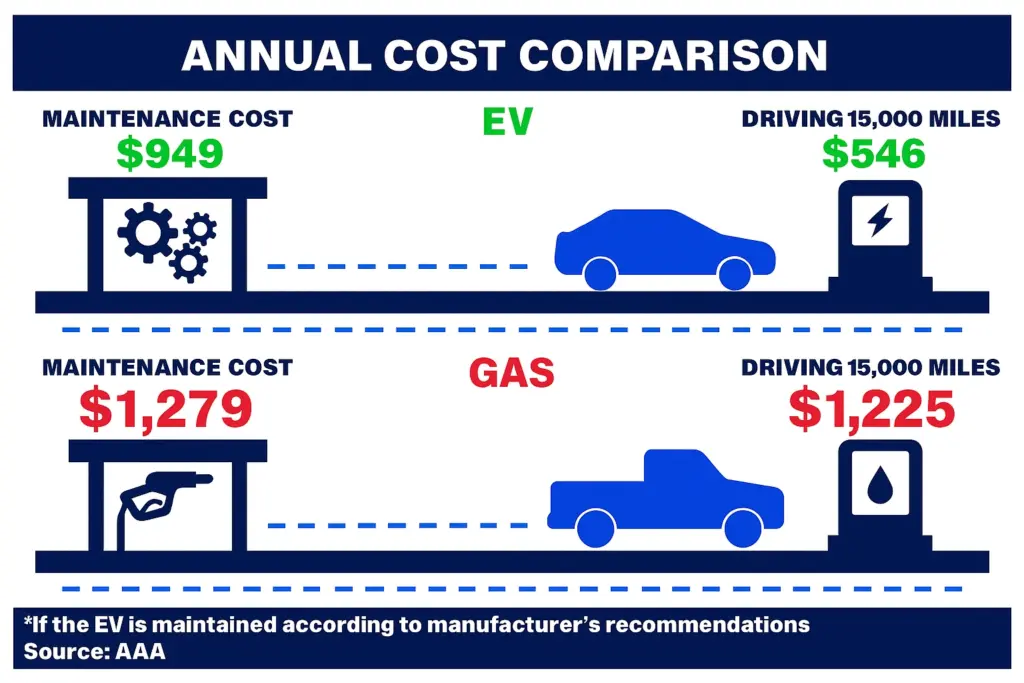
CHALLENGE 1 Annual Cost Comparison
EVs offer long-term cost savings as well as significantly lower maintenance costs, but the upfront purchase price still remains a barrier for many (Fig. 1).
CHALLENGE 2 Range Anxiety
The fear of running out of charge before reaching a destination is a major concern. This fear is driven by limited vehicle range and a perceived lack of charging infrastructure.
CHALLENGE 3 Access to EV Charging Stations
Consumers may hesitate to switch to EVs if they perceive a lack of convenient charging options, especially for long-distance travel.
CHALLENGE 4 Impact on Energy Bill
There is concern about increased home energy bills due to charging needs that could be offset by any potential savings from lower fuel and maintenance costs.
Addressing these challenges through a data-driven approach to siting can facilitate broader EV adoption.
Growing EV Adoption
EV adoption in the US is accelerating, supported by state and local climate goals and technological advancements. Under the Global Warming Solutions Act, as updated by the 2021 Climate Roadmap law, the Massachusetts Executive Office of Energy and Environmental Affairs, for example, has set interim statewide GHG emissions limits of 33 percent below 1990 levels by 2025 and 50 percent below 1990 levels by 2030. Achieving these goals will require a well-developed charging infrastructure.
Criteria for Widespread EV Adoption
Economic
Charging stations must be financially viable and sustainable. Data-driven approaches help optimize placement to reduce costs and improve utilization.
Appealing to Use
Stations must be user-friendly to foster a positive experience. Data can inform their design and location based on user preferences and safety considerations.
Wired to a Capable Power Grid
Infrastructure must be integrated with a power grid that can support increased electricity demand. Data analysis can identify grid-capable areas to minimize upgrade costs.
The Benefits of a DataDriven Approach
A data-driven approach is crucial for accelerating EV adoption and supporting sustainable transportation. Such an approach offers:
• Comprehensive understanding: Identify optimal and accessible locations.
• Informed decision-making: Evaluate factors that influence site suitability.
• Adaptability and scalability: Adjust strategies as market dynamics change.
• Streamlined planning: Reduce the time and resources necessary for planning.
• Cost-effectiveness: Reduce installation and maintenance costs.
A Data-Driven Approach Applied to Recent Projects
For the purposes of this article, there are two key components:
1. Data collection
• Current infrastructure: A comprehensive inventory of existing EV stations and public amenities.
• Land use: The classification of parcels (private vs.
public) and built-environment mapping.
• Demographics: Population density, income levels, commuting patterns.
• Flood risk: FEMA zones and other flood-prone areas.
2. Suitability analysis
• Overlay analysis: Combine multiple digital data layers in GIS.
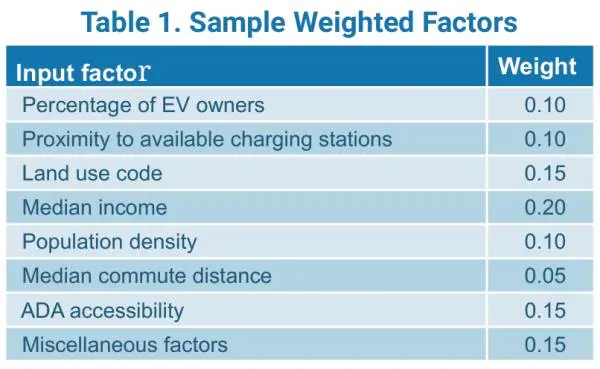
• Multi-criteria evaluation: Weight factors using analytical hierarchy.
• Constraint mapping: Exclude flood zones and other incompatible land uses.
• Site ranking: Prioritize sites by their suitability score.
• Scenario analysis: Evaluate multiple different future scenarios.
Results
An effective suitability analysis will produce a ranked list of potential sites. Interpretation includes:
• Top-ranked sites: Prioritized for implementation.
• Spatial distribution: Ensure regional coverage.
• Sensitivity analyses: Adjust weights to test robustness.
• Ground-truthing: On-site validation for feasibility.
Visualization
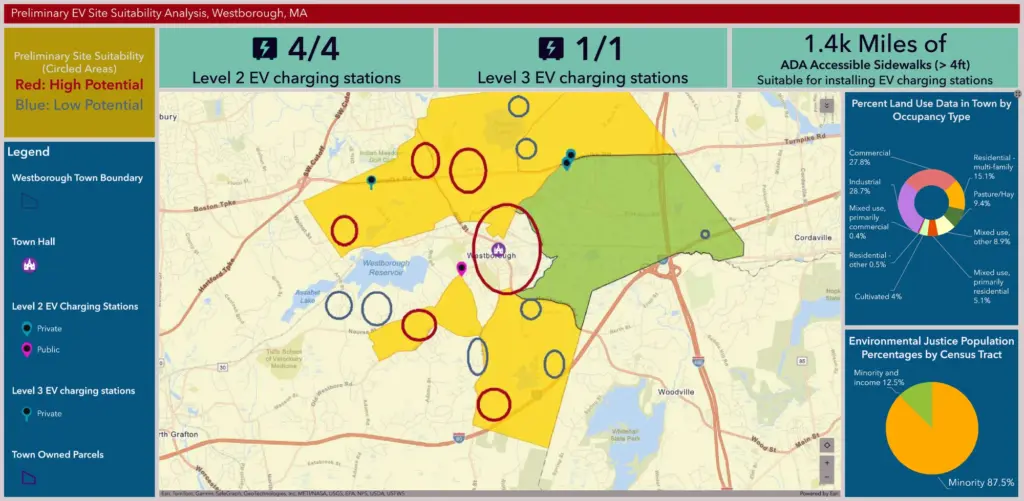
Effective GIS visualization enhances communication with stakeholders and integrates factors like infrastructure, traffic, and accessibility. It also supports strategic decision-making and investment. With all of this data compiled, sorted, and analyzed, an example of what the results and visualization may look like is provided in Figure 2. This example presents a preliminary site suitability analysis for potential EV charging station locations in the Town of Westborough, Massachusetts.
The red ovals indicate high-potential sites identified through a data-driven screening approach, considering factors such as land use, accessibility, and proximity to Environmental Justice (EJ) areas. The blue ovals represent lower-priority locations with marginal suitability. Existing public and private Level 2 and Level 3 EV stations are also shown, along with ADA-accessible sidewalk miles and EJ population data to support equitable infrastructure siting.
Best Practices
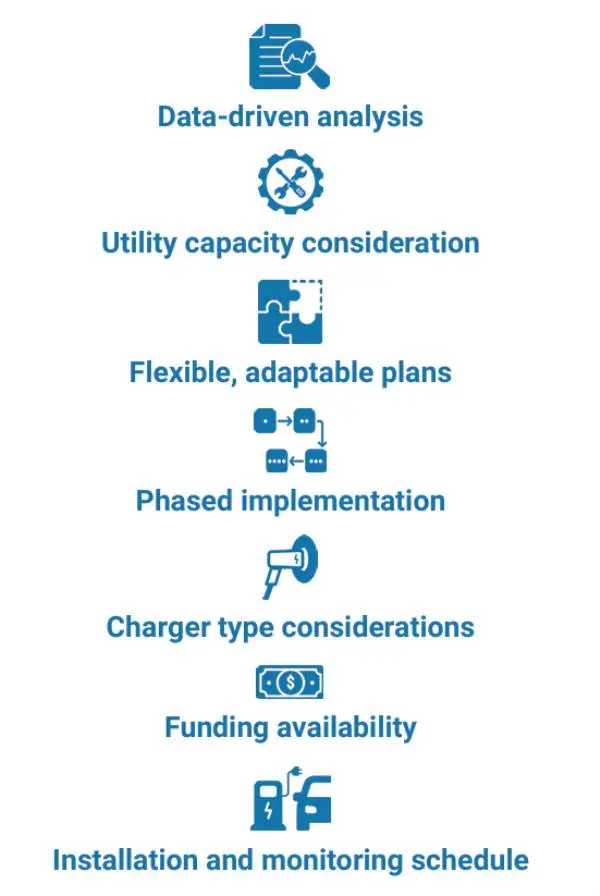
With all of this information on hand, we advise that the best practices for siting new EV charging stations include:
Summary
The transition to EVs is crucial to a more sustainable transportation future, but the strategic deployment of charging infrastructure is equally essential to accelerate the adoption of EVs at a society-wide scale. A data-driven approach that leverages diverse data sources like existing infrastructure and socioeconomic factors can identify optimal locations for new EV charging stations (Figure 3) while also maximizing accessibility, convenience, and utilization. While ongoing efforts like site suitability studies, stakeholder collaboration, technology utilization, and adherence to best practices are vital for success, investments in EV charging infrastructure also help address environmental, social, and economic challenges.
Despite the current dearth of EV stations in comparison to gas stations, a data-driven approach to siting new charging stations can overcome barriers, promote access to clean transportation, and foster a more sustainable and resilient transportation ecosystem.
Originally published in APWA September 2025


