Articles

Groundwater wells are an important drinking water resource for residential, commercial, and industrial purposes. In Connecticut, approximately 60% of residents rely on groundwater as their sole drinking water source. Groundwater wells tap aquifers and allow withdrawal of water for drinking, irrigation, and a variety of industrial purposes. They are, however, also expensive to drill, permit, and to put into service. As such, it is important to maintain and protect these valuable resources.
Most groundwater wells experience a decline in production during their lifetime, which is related to clogging in the near-well environment that reduces the efficiency at which the groundwater flows into the well. In the past, groundwater wells were managed with an “operate to failure” mentality. If water was coming out of the well, there was no need to act until an emergency forced a reaction. Common emergencies that prompted action include damaged or worn-out pumping equipment or a significant loss in production resulting in a lack of supply. Wells operated in this manner can go many years before there is a noticeable difference in production. However, continued operation of wells in this manner results in permanent reductions in well yield and an overall reduced lifespan.
The Capacity of a Typical Gravel-Packed Well Over Time
Figure 1 provides a snapshot of well performance over the lifespan of a typical gravel-packed production well. The highest flow rate and specific capacity (SC) observed in a well is typically documented immediately following construction. SC is calculated by dividing the well pumping rate (discharge) by the drawdown (change in water level) and is represented as gallons per minute per foot of drawdown (gpm/ft or gpf). A well often maintains the initial SC for several years without any maintenance on the well, until the SC begins to drop without much change in the flow rate of the well. When the decline in flow rate becomes noticeable, rehabilitation of the well is then conducted to increase the SC and flow rate of the well. But this rehabilitation is not permanent.
The typical gravel-packed production well is often operated for many years after this initial rehabilitation with the SC and flow rate dropping at a steeper rate than initially realized after the well was originally placed into production. Eventually, another well rehabilitation is conducted, after which the well again fails to maintain the regained SC or flow rate for very long, showing an even steeper drop in both SC and flow rate. By the time of the third well rehabilitation in year 37 (as shown in the Figure 1 example), the SC can only be increased to 50% of the original SC, and the original 165 gpm well can now only produce 60 gpm. In other words, the success of the well rehabilitation process has diminishing returns when the rehabilitation is not performed frequently enough. The aquifer still has the capacity to produce 165 gpm, but the well can no longer efficiently transmit that amount of water to the pump at that rate. In this scenario, the well will need to be replaced to meet the rated capacity and pump at the desired flow rate.
The timing for the decline in production of a well is based on many things, including water quality, geology, and the rate of bacterial growth and related mineralization. The measurable decline in a well can take as little as 12 months or sometimes even many decades to be realized. Recovering lost production in a well is accomplished by rehabilitating or redeveloping the well. Studies suggest that if a well loses 30% of its original capacity, it is impossible to fully regain that lost production. In the many
decades that Weston & Sampson CMR/ SB Church has been servicing groundwater wells, we have observed this to be true – the chance for well rehabilitation to fully regain lost production occurs less often when more than 30% of the SC has already been lost.
WHY WELLS FAIL
The reason for the decline in production of groundwater wells is that the nature of operating a well creates conditions that draw nutrients and chemicals from the aquifer to a single withdrawal location – the near-well environment including and adjacent to the well screen. The collection of these nutrients and chemicals allows for the growth of biological and mineralogical materials that can clog the pore spaces in and around the well. As pore spaces clog, groundwater velocity in the near-well environment increases and physical materials like silt and fine sand can mobilize and further clog pore spaces. When enough clogging occurs, the well’s specific capacity declines. Eventually the specific capacity declines so much that the volume of water the well can produce decreases, which, if not addressed soon enough, will cause the well to fail and need to be replaced.
Preventative Maintenance Can Extend the Useful Life of a Well
In recent years, there has been a shift in the mentality of well operation into a more preventative maintenance approach. With a better understanding of what is happening in the near-well environment, water operators have begun to take the necessary actions to extend the operational life of groundwater wells and pumping equipment.
The most important thing a water operator can do is to regularly monitor and record the flow rate and water level in the well during pumping, maintaining a pre-determined safe pumping water level. Screened wells should be operated at a pumping rate that does not draw down the pumping water level below the top of the screen. Doing so accelerates biological growth and clogging. It is also recommended to conduct operational testing of the pumping equipment and well on a regular basis to determine the operating condition of the equipment at different flow rates to identify and address any issues before they become emergencies.
What can be done to regain lost production? The well service industry has long been providing methods for treating wells to recover lost production. The well rehabilitation process takes energy to remove the materials clogging a well, which can come in the form of physical and/or chemical energy. Conventional chemical and physical treatments have long been the standard for well rehabilitation, but recent technologies include high pressure jetting, hydrofracturing, percussive energy, and the use of gaseous and liquid carbon dioxide (Aqua Freed®) for both gravel-packed and bedrock wells.
One industry-recommended approach to extend the life of a groundwater well is to rehabilitate the well often enough to remove the buildup of biofilms and associated minerals prior to losing 30% of the original SC. Ultimately, each well and near-well environment is different and requires a different approach.
The well rehabilitation techniques referenced above require anywhere from 5–10 days to complete based on the selected method and how the well is responding to the treatments. The time and effort spent rehabilitating the well can be recovered by restoring lost production and extending the life of the well. A well might require rehabilitation every five years or possibly even more frequently, depending on the rate of clogging. Some problematic wells may require annual rehabilitation to maintain production.
Permanently Installed Preventative Maintenance Techniques
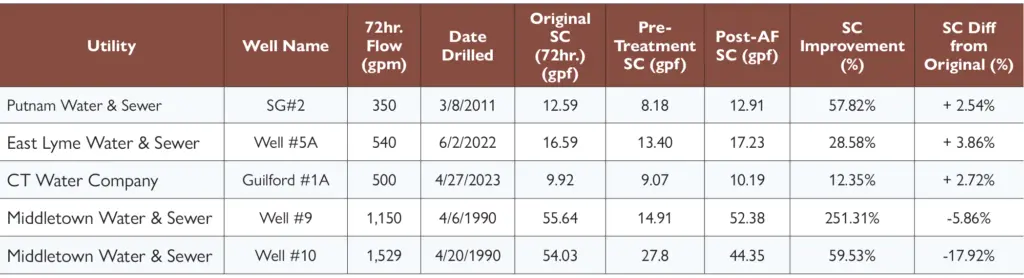
Weston & Sampson CMR/SB Church recently acquired the license to use Aqua Freed® and Aqua Gard® in Connecticut, and initial well rehabilitation results using Aqua Freed® have been positive. Aqua Freed® utilizes the phase change energy of carbon dioxide in a controlled manner that breaks up and loosens materials that are clogging the near well environment. Example improvements in specific capacity using Aqua Freed® are presented in Table 1. These improvements were realized with a step-rate flow test after installing the pumping equipment in the well following the well rehabilitation. The post-Aqua Freed® (AF) SC is the SC calculated at the highest flow rate during the step-rate flow test. The highest flow rate achieved during post treatment testing for the East Lyme Well, Middletown #9, and Middletown #10 was 412, 540, and 745 gpm respectively. Another five wells are slated for Aqua Freed® well redevelopment in the coming months.
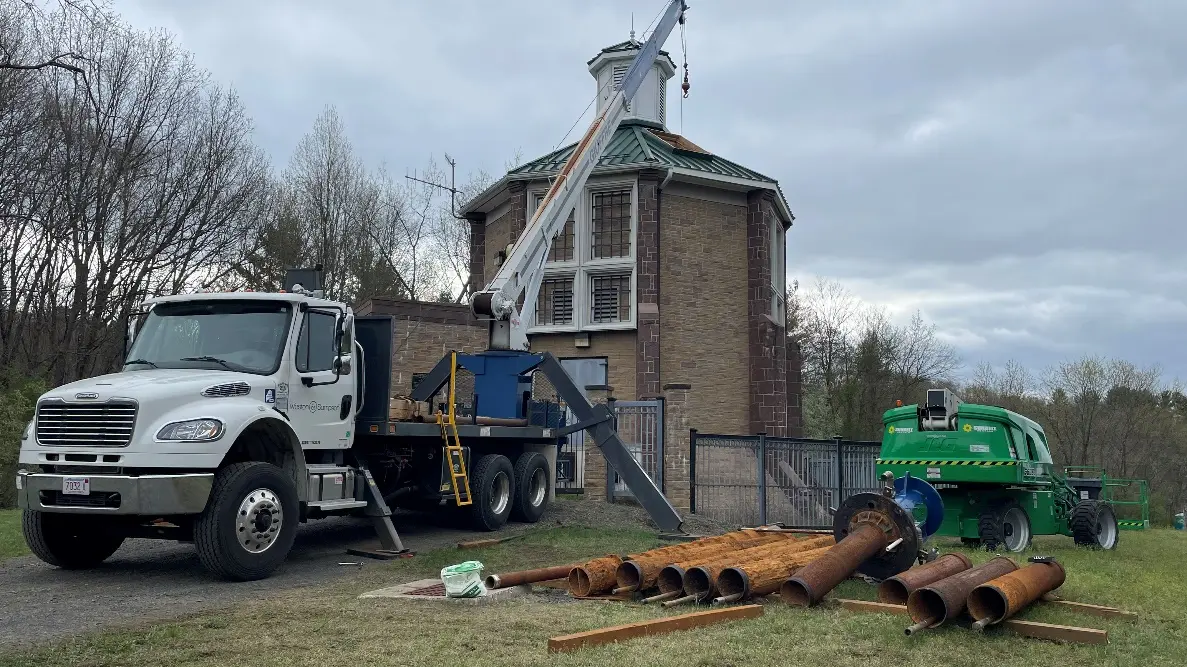
Removing the pump is necessary in any well rehabilitation effort to safely introduce the necessary energy to remove biofilms and associated minerals. Aqua Freed® uses a traditional well rehabilitation approach of removing the pump to access the well. The goal of the Aqua Freed® rehabilitation is to regain as much lost SC as possible. Similar to Aqua Freed®, the preventative maintenance process Aqua Gard® utilizes the phase change energy of carbon dioxide to loosen and detach biofilms before they harden and become more difficult to remove. Unlike traditional well rehabilitation, Aqua Gard® allows for treatment of a well without the need to remove the pumping equipment. Aqua Gard® requires the installation of specialized equipment permanently in the well, usually done during initial construction or following a well rehabilitation effort with Aqua Freed®. The goal of the Aqua Gard® treatments is to maintain the SC of the well by removing clogging materials before they harden and require more energy to remove. Following the installation of the specialized equipment, preventative maintenance can be performed by a well contractor on the well with the pumping equipment in place, allowing for a quicker turnaround for getting the well back online. A typical downtime is 2–3 days for the Aqua Gard® process, allowing problematic wells to be treated annually or semi-annually at a much lower cost than traditional well rehabilitation. Weston & Sampson CMR/SB Church has installed one Aqua Gard® setup and the first Aqua Gard® treatment is slated for fall 2025. A second Aqua Gard® installation is also slated for fall 2025. The benefits of Aqua Gard® will be evaluated on these installations over the next few years.
Summary
Whatever methods you choose to maintain your groundwater wells, there are benefits to taking a more preventative approach rather than a reactive approach to maintaining the production and longevity of groundwater wells. Any upfront costs related to rehabilitating and maintaining a groundwater well are typically offset by the maintained production and the money saved by not needing to drill, permit, and connect a replacement well.
Published in InFlow-Line November 2025.


